Research overview

Our current research focus on strongly correlated quantum systems where interactions are comparable to kinetic energy. Such situations often lead to novel macroscopic quantum phenomena such as high-temperature superconductivity or the fractional quantum Hall effect. These systems are interesting from a fundamental point of view (phases, types of excitations …) and could find applications such as lossless energy transport or quantum information processing.

The study of quantum many-body systems remains however very challenging for numerics and one needs to develop new approaches both from theory and experiments. One possible experimental route, called quantum simulation, aims to use a well-controlled device whose constituents behave quantum-mechanically to study problems intractable for classical computers. In our laboratory we use ultracold neutral atoms trapped in optical potentials to perform quantum simulations of strongly correlated systems. We probe such systems both in and out of equilibrium with a resolution down to the single particle and spin, allowing us to directly measure local and non-local correlations.

The experiment

Strontium energy level diagram
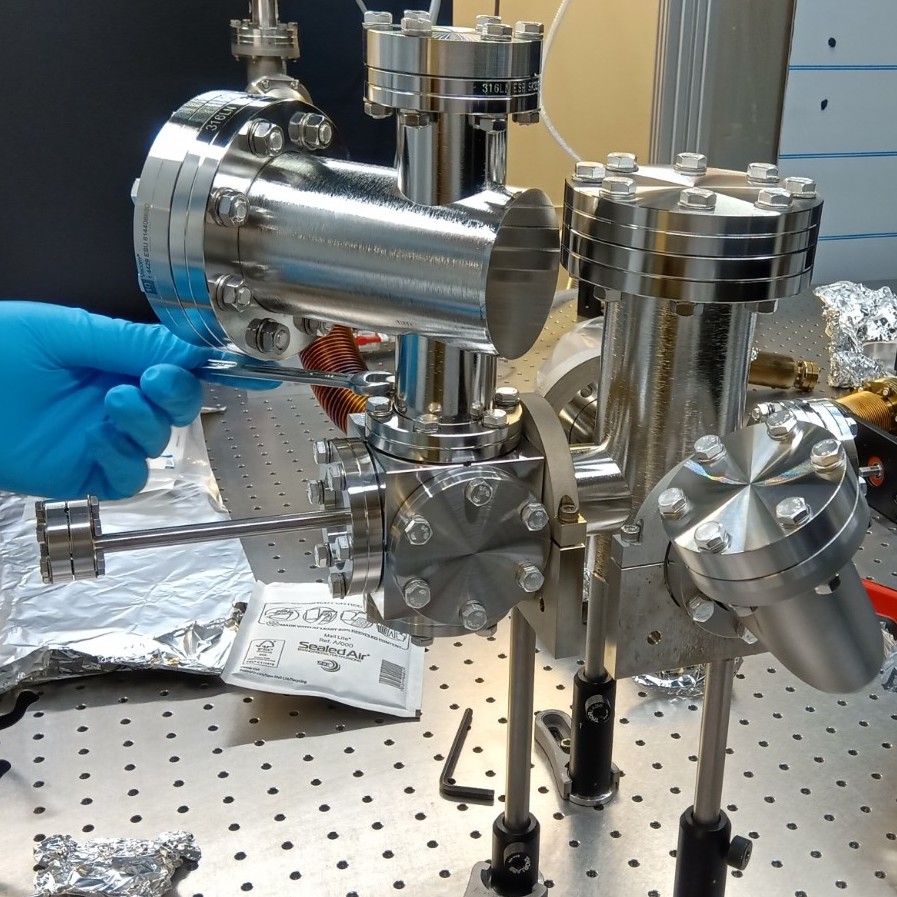
The bare experimental setup
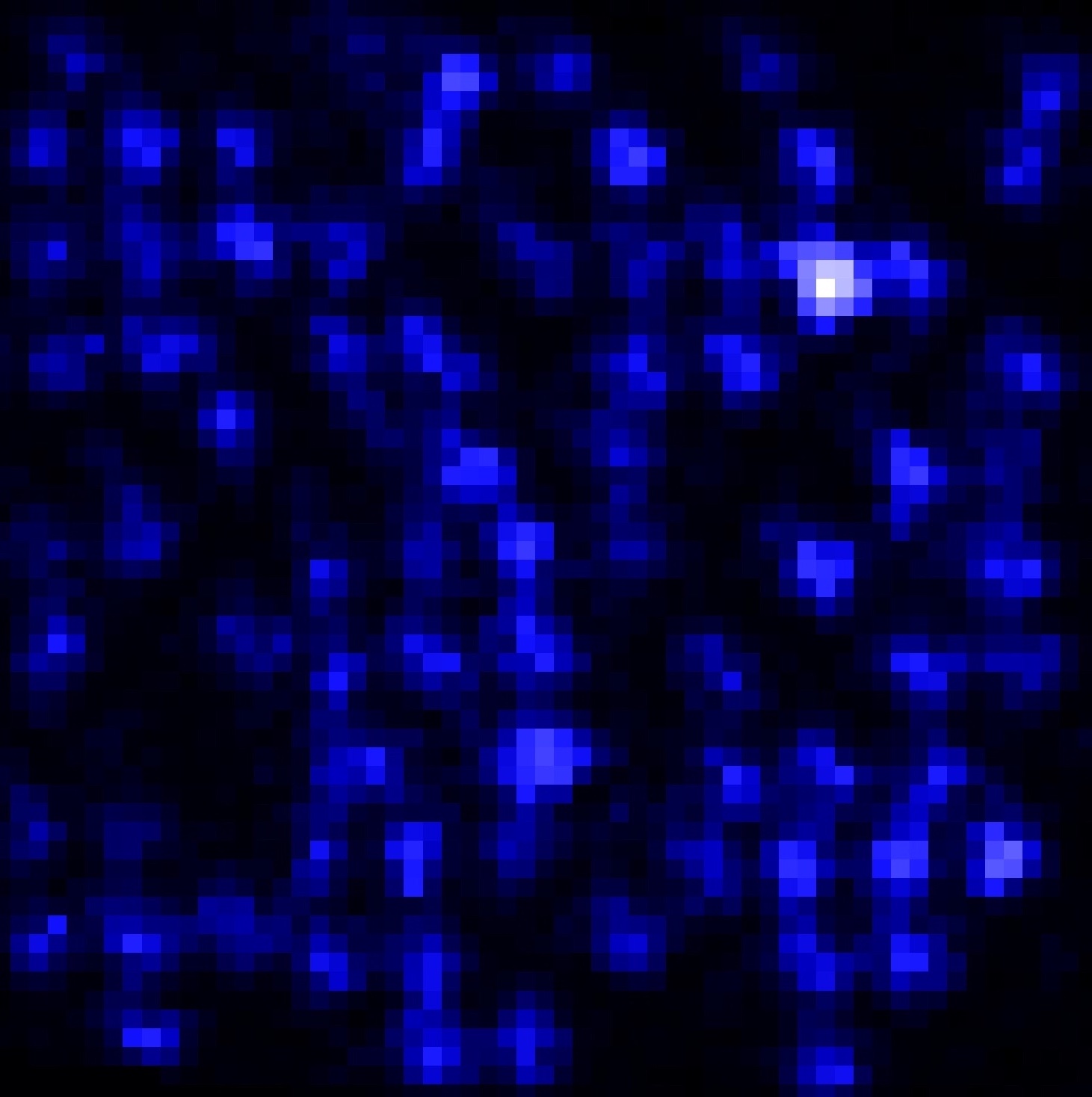
Single-atom position detection in the reservoir trap

Since October 2021 we have been setting up a novel quantum simulation platform based on Strontium atoms with single particle detection and control.

This alkaline-earth atom used in the current best optical clocks has both broad and narrow optical transitions which are convenient for laser cooling close to degeneracy. It furthermore has three stable bosonic isotopes and one fermionic isotope with vastly different collisional properties. With a nuclear spin 9/2, the fermion enables the study of exotic phenomena using synthetic dimensions and allows us to address SU(N) magnetism with N>3. Finally, the existence of clock states is at the origin of highly coherent single-photon Rydberg excitation approaches to engineer spin models, making strontium very attractive for quantum simulation.

In order to harness the nuclear spin as a resource for quantum information processing, we have recently developed a rapid imaging technique operating on a 100 microseconds timescale, allowing us to detect up to four nuclear spin states with single-atom resolution. Implementing this approach with dynamical optical potentials will open new perspectives for quantum simulations with SU(N) fermions and for computations with qudits, which we plan to explore.

ERC starting grant project FLATBANDS

Research directions

Probing strongly correlated systems with single particle and spin resolution in so-called quantum gas microscopes offers novel perspectives to study quantum many-body systems.

An important class of quantum many-body systems is topologically ordered phases. In these highly-entangled phases, the order is encoded non-locally and hence has been predicted to be protected from local decoherence. Such phases are thus very interesting from a quantum information perspective and are the object of intense recent experimental and theoretical investigations. The ability to detect both the internal state and the position of all particles simultaneously allows us, for example, to directly measure non-local correlations, which is essential to detect topological order beyond the Landau paradigm of symmetry-broken phases.
Within the ERC starting grant project FLATBANDS, we will explore highly-entangled phases such as fractional quantum Hall states and quantum spin liquids.

Our first experimental challenges will be:

  1. The production of mesoscopic quantum gases with high repetition rate.
  2. The development of spin-resolved quantum gas microscopy for strontium.
  3. The production of large and programmable three-dimensional optical tweezer arrays filled with exactly one atom per tweezer.